
An event photographer is a professional who captures the atmosphere, key activities and candid moments of public or private gatherings. They cover corporate functions, conferences, product launches, award galas, festivals, concerts and private parties, working live, in real time, with no second take.
Most people asking what an event photographer is are trying to work out what they’re actually paying for. Is this just a professional photographer with a different booking form?
It’s a service role as much as a creative one, which is why the good ones are booked out months ahead. Professional photography at a live event is as much about the preparation and the delivery as it is about taking pictures on the day.
What an Event Photographer Actually Does
The easiest way to understand the role is to follow one job from booking to delivery.
Take a 300-person conference with a keynote, a panel, a trade show floor and an awards dinner.
The Week Before
The photographer gets the run sheet and marks the important moments that can’t be missed: the keynote walk-on, the sponsor presentation, the award handover.
They also confirm the key people who have to appear in the gallery, because a set of photos without the CEO or the award winners in it has failed before it’s edited.
They talk to the event organisers about what the images are for.
Social? Press? The annual report? Sponsor reporting? Those answers change what gets shot and how it’s framed, and they settle the client’s expectations before the day rather than during it.
Then the boring, essential part. An equipment checklist, batteries on charge, cards formatted, bodies and lenses tested.
Gear that fails at 7 pm on a Friday is a problem you solve on Tuesday, not on the night.
Ninety Minutes Before Doors
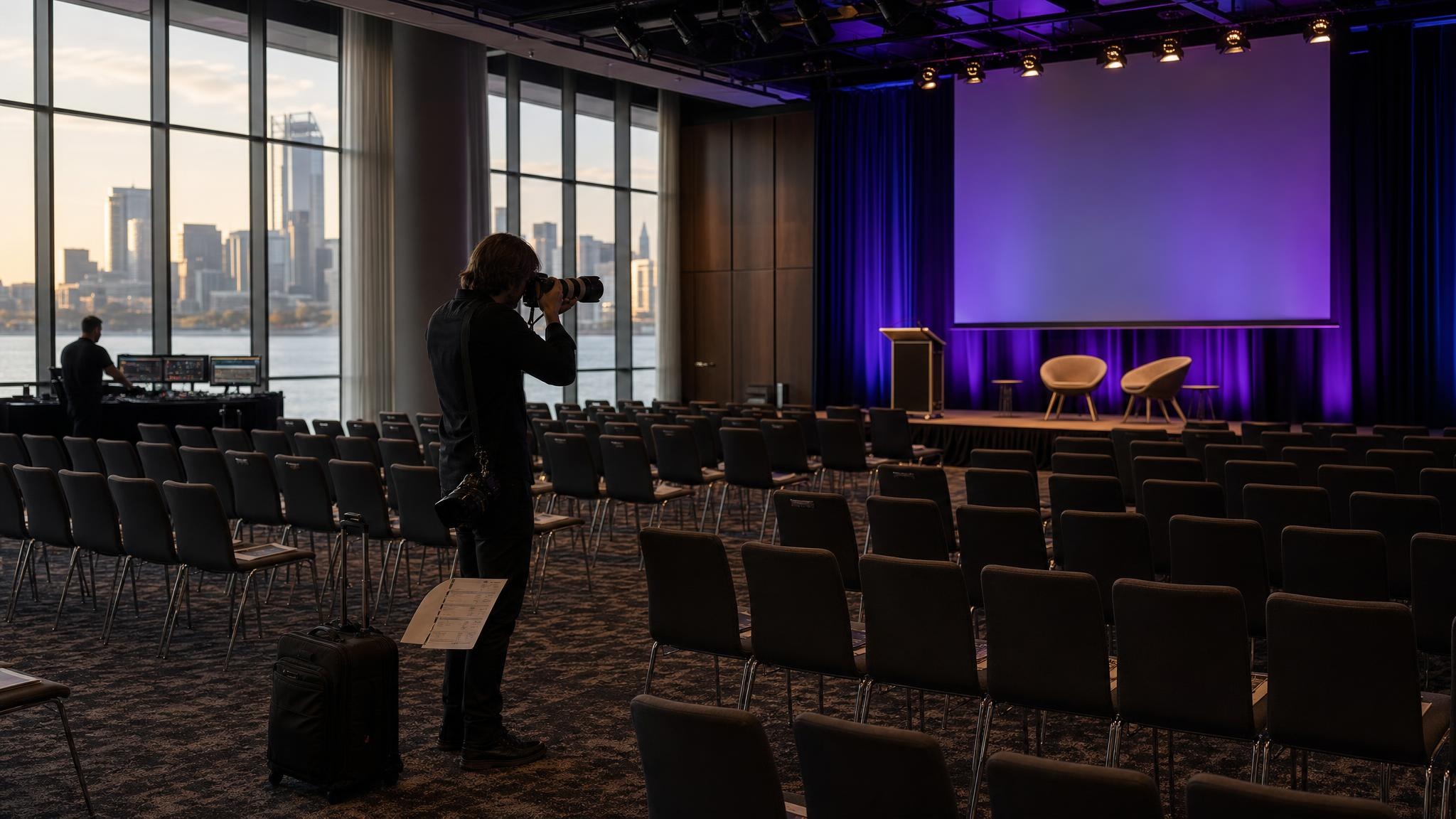
They arrive early. Walk the room empty, before the crowd makes it impossible to see.
Find the shooting positions for the stage, check what the house lighting is doing, and test camera settings against the actual stage lighting rather than guessing.
Note where the exits, the cabling and the AV desk are, because those are the things you back into when you’re watching the viewfinder.
Across the Day
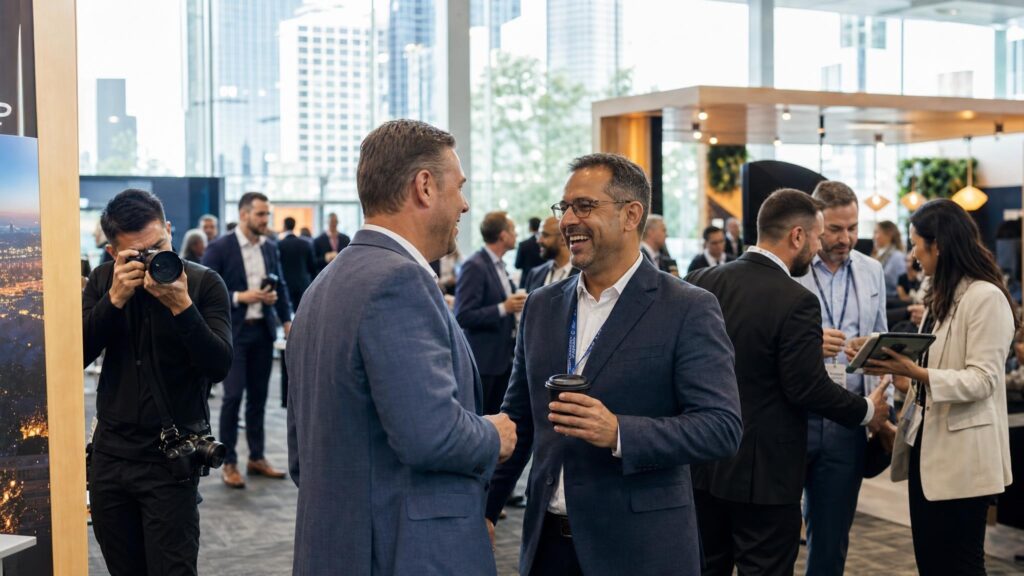
Live coverage means moving with the event and capturing moments as they happen. Registration and arrivals, the keynote, audience engagement among the event attendees in the room, the trade show floor, the breakout conversations, then the dinner and the awards.
Some of it is deliberate: posed photos, group shots, the sponsor logo captured cleanly. Most of it is watching and waiting for the candid interactions that make the gallery worth having.
The run sheet tells you where the scheduled moments are. It won’t tell you where the special moments are, and those are usually the ones people remember.
The Days After
Post-production is where the job gets finished and the visual narrative of the day comes together. Cull hard, colour correct, batch edit for a consistent look, then a final pass on the frames doing the heavy lifting before the final images go out.
Event photographers usually work to tight deadlines, because the photos have a job waiting for them. A preview set for social within 24 hours, the full gallery to follow.
The shoot is the visible part of the role. The planning and the post-production are where it’s won or lost.
The Skills That Make a Good Event Photographer
Technical Proficiency Under Pressure
Strong command of camera settings and photo editing, applied in changing lighting conditions with no chance to reset.
A studio is a controlled environment. An event is the opposite, and the technical skill only counts if it works at speed.
Organisation and Time Management
Efficient workflow, a real equipment checklist, and a delivery schedule that holds up when three jobs land in the same week.
This is an unglamorous skill that clients feel immediately, usually when the images don’t arrive.
Interpersonal Skills
Directing group shots without killing the mood, making subjects comfortable, and reading a room full of strangers.
Most people underrate this one. It’s the difference between relaxed, high-quality images and forty photos of people who look like they’re being processed.
The Ability to Disappear
Good event photographers blend into the background for candid shots. Candid moments often become the highlights of the gallery, and you only get them when nobody is performing for the camera.
A flexible shot list is what makes that possible. Lock the non-negotiables, then leave room for the spontaneous.
Adaptability
Speakers run late. The light drops. The room moves. Adapting quickly is the job, not a bonus, and it’s why this stays a dynamic field rather than a repeatable one.
The Events an Event Photographer Covers
Corporate Functions
Conferences, business meetings, trade shows, product launches, brand activations and awards nights. Corporate event photography is the commercial end of the field, because the images carry the brand.
This is the bulk of what our team does through corporate photography and event photography.
Public and Creative Gatherings
Festivals, music festivals, concerts, community meetings and theatrical shows.
Concert photography needs specialised equipment for stage lighting and low light, because flash is usually off the table.
Sports Events
Fast-paced action, long lenses, and anticipating the play rather than reacting to it.
Private Events
Milestone birthdays, birthday parties, anniversaries, private parties and family reunions.
These jobs are about capturing precious moments for the people in the room rather than for a brand, and the precious moments that matter are almost never the ones on the schedule.
Weddings
Wedding photography is a major specialisation within event photography, and a wedding photographer is generally a specialist rather than a generalist.
birds eye media works the commercial side, so weddings aren’t something we take on.
For the full breakdown of the category, read what is considered as event photography.
What to Expect When You Hire an Event Photographer
Book 4 to 8 Weeks Ahead
That’s the standard lead time.
Awards season, EOFY and the run into December book out earlier, so move sooner if your event lands in a busy window.
Agree the Hours Up Front
Decide how many hours of coverage you need, and which hours specifically. Most photographers offer quarter-day, half-day and full-day options.
You rarely need the entire day. You need the two hours either side of the moment that matters.
Ask Whether You Need a Second Photographer
For multi-room conferences, large events or anything running two stages at once, a second photographer isn’t an upsell. It’s the only way to actually cover it.
Second shooting also gives you more angles on the key moments, which matters when the best shots come from the side of the room nobody was standing in.
Confirm the Deliverables
Number of final photos, turnaround, editing style, file formats, usage rights, and print packages if you want them. Get it in writing before the event, not after.
As a rough benchmark, expect somewhere around 50 to 75 edited images per hour of coverage. A quote that won’t commit to a number is a quote worth questioning.
Check Insurance and Venue Access
Most corporate venues, and every industrial site, will ask for a certificate of currency before your photographer gets through the door.
birds eye media carries $20 million public liability cover for exactly that reason.
If your event is on an operational site, ask whether the photographer can pass an induction and work safely around live plant. Plenty can’t.
Brief Them Properly
The best results come from a photographer who knows what the images are for. A happy client is almost always one who spent twenty minutes on the brief.
The gap between a gallery that’s fine and one the client calls absolutely fantastic is usually decided in that conversation, not on the night.
Need an Event Photographer for Your Event? birds eye media is Ready to Help!
A good event photographer is part planner, part technician and part quiet presence in the room. You’re paying for the preparation and the post-production as much as the shoot itself.
If you’ve got a conference, a launch, an awards night or a site event coming up, talk to us early. Four to eight weeks is the standard lead time, and the busy windows go sooner.
Our event photography services cover corporate functions, launches, awards nights, festivals and site milestones nationally, so whether it’s a conference or a basketball match, we’ve got a crew for it.
Tell us what the images are for, how many hours you need covered, and whether the venue wants a certificate of currency.
Reach out to us, and we’ll help you scope the coverage properly before the date fills up.