
Event photography is the professional practice of documenting the people, atmosphere, and key activities of a live occasion as it happens. It covers corporate events and conferences, galas and award ceremonies, brand activations and product launches, festivals and performances, sports, and private social gatherings.
What separates it from studio work is control, or the lack of it. In a studio, the photographer owns the light, the timing and the subject. At an event, they own almost nothing except their own preparation.
Most people asking what is considered event photography are really asking a practical question: does the thing I’m organising need a professional event photographer, or will someone with a decent camera do?
The Main Types of Events We Cover
Event photography is a broad category, and the skill set shifts with the room.
Here’s what that looks like across the work our team actually does.
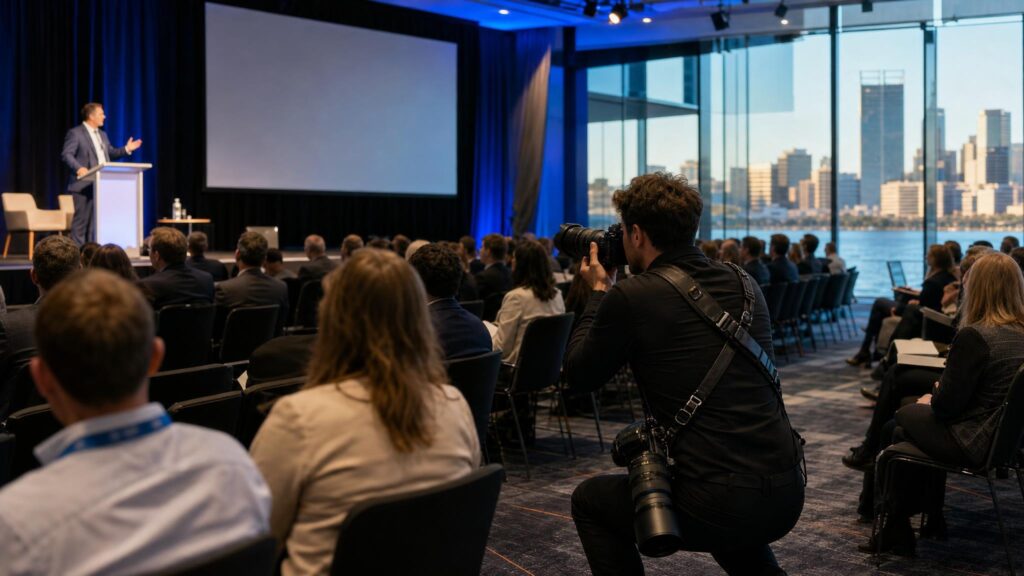
Corporate Events, Conferences and Business Functions
Conferences, business functions, keynote speeches, panels, trade shows, annual summits and staff functions.
The brief here is brand representation and internal communications. That means key people on stage, engaged event attendees in the audience, branded signage caught cleanly, and candid interactions during the breaks.
Corporate event photography is the most commercially demanding category, because the images carry the brand.
We’ve done this work for Westpac, BHP, the University of Western Australia and the WA Government, through our corporate photography and event photography services.
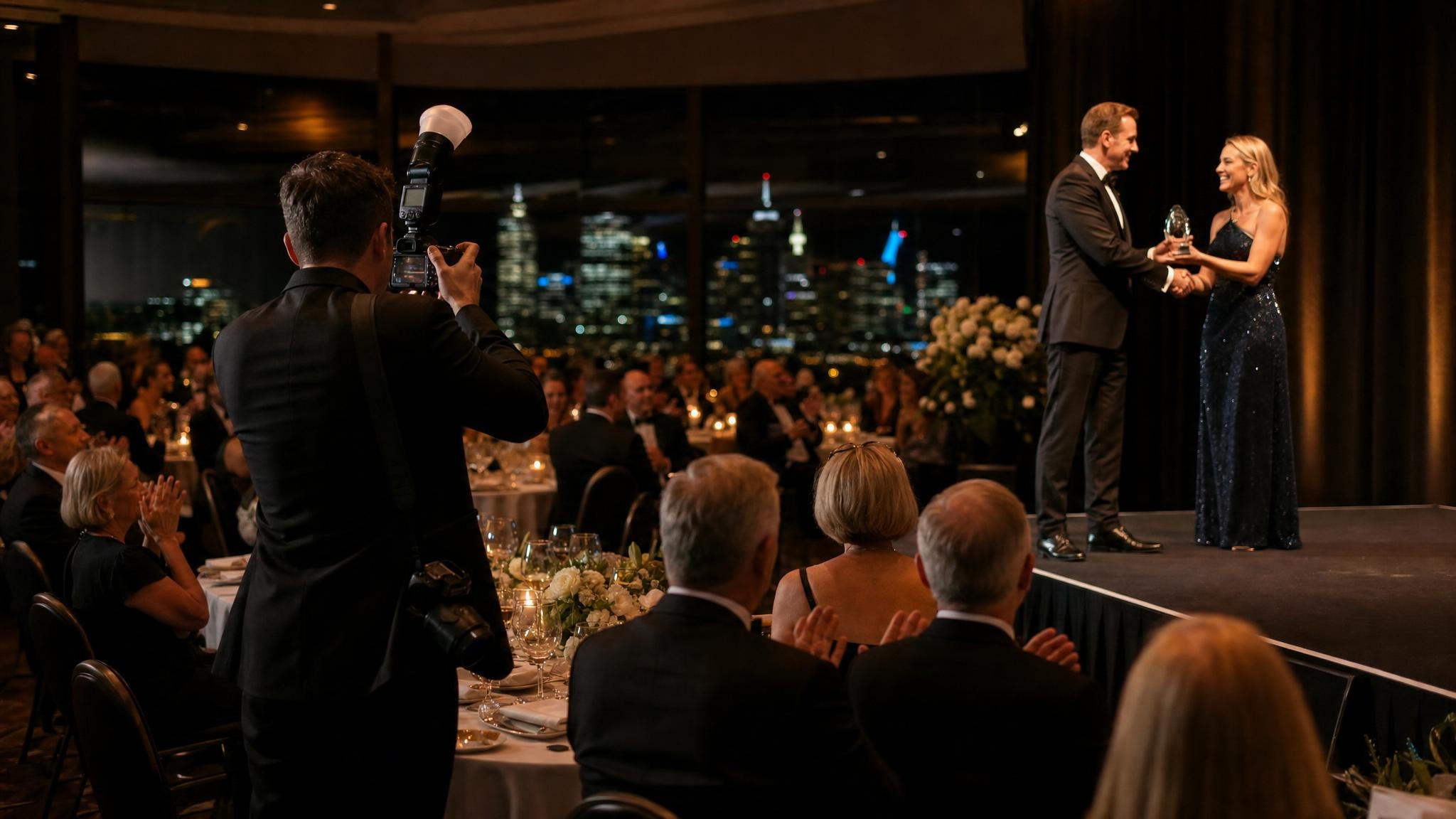
Award Nights, Galas and Formal Functions
Black-tie dinners, industry awards, step-and-repeats, presentation key moments and posed group shots.
Award ceremonies are unforgiving on timing. The trophy handover lasts about four seconds, in stage lighting designed for the audience rather than the camera.
Product Launches and Brand Activations
Corporate launches, experiential marketing setups, pop-up spaces and promotional reveals.
Clients usually need assets the same day or the next morning, so the post-event workflow matters as much as the shoot.
Festivals, Concerts and Public Celebrations
Live music, community events, festivals and public celebrations. We shot the Angus Stone concert at Esplanade Park for Zaccaria Concerts.
Concert photography leans hard on fast lenses and high ISO capability, because flash is often banned and the lighting changes every eight bars.
Sports and Stadium Events
Sports photography needs a telephoto lens, quick anticipation and an actual understanding of the game. You can’t follow the action if you don’t know where it’s going next.
We’ve worked in stadium and broadcast environments including Optus Stadium, Fox Sports, the NBL and WWE. Accreditation, crowd management and locked-down shooting positions are part of the job at that level.
Site Milestones, Mining and Industrial Events
Sod turnings, site openings, plant commissionings, safety milestones and executive site visits.
These are events, but they happen in hi-vis on operational ground. They need a crew who can pass an induction and work around live plant without becoming a hazard. It’s part of why we carry $20 million public liability cover.
Special Occasions and Celebrations
Milestone birthdays, anniversaries and community gatherings. These sit at the personal end of what we do, and they’re priced below corporate work.
Where Wedding Photography Fits
Wedding photography is technically a form of event photography, and it’s the one most people picture first. It’s also its own specialisation, with its own timelines, traditions and expectations.
birds eye media works the commercial side of this category, so weddings aren’t something we take on.
Conferences, galas, activations, launches, festivals and site events are where we live.
What a Professional Event Photographer Actually Does
Pre-Event Planning
Pre-event planning is what separates successful event photography from a hopeful afternoon with a camera.
It means checking in with the event planner or comms lead, understanding venue conditions, walking the space, and identifying the key people who have to appear in the gallery.
Building a Flexible Shot List
A shot list locks in the non-negotiables. The CEO on stage. The sponsor signage. The award presentation. The large groups.
Keeping it flexible leaves room for spontaneous key moments, which is where the best shots usually come from anyway.
Working the Room on the Day
Reading the room and capturing moments and people rather than just the venue.
Good event photographers are close enough to get the frame and invisible enough that nobody remembers they were there. We don’t show up and wing it.
The Post-Event Workflow
Culling first, then batch editing in Lightroom for quick adjustments across multiple images, then a final pass on the frames doing the heavy lifting.
A consistent editing style is what makes the set look like one event instead of forty separate photos. Post-event workflows exist to hit the client’s delivery deadline, not the photographer’s convenience.
AI editing tools have compressed this enormously. Software can now process a gallery of wedding-scale images in under 20 minutes, which shifts the professional’s real value onto the culling and the judgment calls.
What Makes Event Photography Different
It’s Candid and Dynamic
Event photography relies heavily on unposed interactions, natural expressions and real-time energy.
Candid event photos carry genuine emotion in a way a lined-up frame never does, and candid interactions at a trade show stand will always beat a static shot of the stand itself.
Posed shots still matter. Every event shoot needs a handful of posed group shots and group photos of sponsors and executives. But the story lives in the candid moments.
It’s Fast-Paced and Uncontrolled
Photographers have to adapt quickly to shifting lighting conditions and low-light situations, often in high-pressure environments.
A single event can run from window light in a foyer, to a hard stage wash, to a dark dinner service, inside an hour.
Camera settings that worked at 6 pm are useless by 8 pm.
It’s Storytelling, Not a Slideshow
Storytelling is essential because the gallery has to communicate the event’s progression: arrival, build, peak, wrap.
Environmental awareness helps frame shots that show scale and context. A wide frame of a full room is often the image that proves the event worked, and the one that ends up in the annual report.
It’s Service-Oriented and Client-Driven
Event photography is a service business first. The photographer’s responsibilities include reading the client’s expectations, staying out of the way, and delivering usable final images on a deadline. Technical skill is the entry ticket, not the job.
The Gear and Technical Skill Behind the Job
The equipment checklist is worth understanding, because it explains why a professional costs what they cost.
Two Camera Bodies, Always
Event photographers should carry two camera bodies for reliability. One body means one point of failure at an event that can’t be re-run.
Fast Lenses, Zoom Lenses and a Telephoto
A fast lens is essential for low-light event photography. A zoom lens is ideal for capturing action from a distance without wading through a crowd, and a telephoto lens covers stage and sports work.
The best cameras for events share the same key features: unparalleled autofocus, clean high ISO performance, long battery life and dual card slots.
Flash, Done Properly
A hot-shoe-mounted flash bounced off a ceiling produces far better lighting than direct on-camera flash.
Direct flash flattens faces and makes a $40,000 corporate event look like a snapshot.
Memory Cards, Batteries and Redundancy
Memory cards with ample storage, spares for everything, and a habit of backing up before leaving the venue.
Camera Settings Under Pressure
Shutter speed fast enough to freeze a moving hand. White balance corrected for mixed venue lighting. ISO managed, so the high-quality images still hold up when they’re printed at A4.
Capturing high-quality images in a dark ballroom is a technical skill, not a preset.
How to Choose an Event Photographer
Look at a real photography portfolio of events, not portraits. A professional online portfolio of studio headshots tells you nothing about how someone performs in a dark room.
Ask what they shot recently in bad light and how they handled it. Ask whether they carry two bodies and backup gear. Ask who is actually turning up on the day, because at some agencies it isn’t the person you met.
Check the insurance. birds eye media carries $20 million public liability cover, which is what most venues and corporate clients want to see before you get through the door.
Sort out usage rights up front, because these are marketing assets and you need to know what you can do with them.
Need a Professional Event Photographer? Contact birds eye media Today!
Event photography rewards preparation, judgement and gear that doesn’t fail halfway through the keynote.
Whether you’re running a conference, an awards night, a product launch, a festival or a site milestone, our team turns up ready, works the room without getting in the way, and delivers usable images on your deadline.
We’re fully insured with $20 million public liability cover, and we’re accustomed to corporate, stadium and industrial environments.
Get in touch with us to talk through your event and lock in your date.